The nervous system as your inner universe

Most of us were never taught that the nervous system is something we can have a relationship with. We were taught that it operates automatically, beneath the threshold of conscious influence, doing its job of keeping us alive while we get on with the business of living. And while that is partially true, it is also one of the more limiting ideas we have inherited from a reductive model of biology that is, slowly but meaningfully, being revised.
What we are beginning to understand, through both cutting-edge neuroscience and the rediscovery of ancient contemplative knowledge, is that the nervous system is not simply a relay station for signals between brain and body. It is the very medium through which we experience reality. Every perception you have ever had, every emotion, every sense of meaning or meaninglessness, every moment of connection or isolation, has been shaped by the state your nervous system was in when you had it. Which means that the quality of your nervous system is, in a very real sense, the quality of your life.
The state you're in shapes the world you see
This is one of those ideas that sounds abstract until you feel it directly. Think of a time when you were genuinely rested, open, and at ease, and how differently the same circumstances appeared compared to when you were depleted, hypervigilant, or shut down. The external facts may have been identical, but your access to creativity, to compassion, to possibility, was entirely different. That difference was not a matter of willpower or perspective. It was a nervous system state, a biological reality that was shaping your perception from the inside out.
Contemplative traditions have mapped this territory in extraordinary detail over thousands of years, describing states of consciousness, levels of awareness, and the conditions under which human beings can access deeper dimensions of their own intelligence. What is remarkable is how precisely these maps are beginning to correspond to what neuroscience is now describing in its own language. The ancient understanding that there are multiple layers to human experience, from the most contracted and survival-oriented to the most expanded and unified, turns out to align very closely with what we now know about the architecture of the nervous system and its remarkable capacity for transformation.
Regulation as a spiritual practice
In many spiritual communities there has historically been a subtle hierarchy that privileges the transcendent over the embodied, the mind over the body, the celestial over the earthly. Meditation, prayer, and contemplative practice have sometimes been framed as ways of rising above the body rather than moving more fully into it. But this framing misses something essential, and it is something that both modern neuroscience and the more embodied streams of spiritual wisdom have always known: you cannot think or believe your way into a different state of being. The nervous system has to be involved.
Regulation, in this context, does not mean suppression or control. It means the capacity to move fluidly between states, to come back to a baseline of safety and openness when life pulls you into contraction, and to do so not through force but through a genuine reorganisation of the system itself. This is precisely what the great contemplative practices, from Vipassana to pranayama to certain forms of movement and somatic work, have always been facilitating, even when the language used to describe them had nothing to do with neuroscience. They were, and are, technologies for nervous system transformation.
The spine as the axis of this transformation
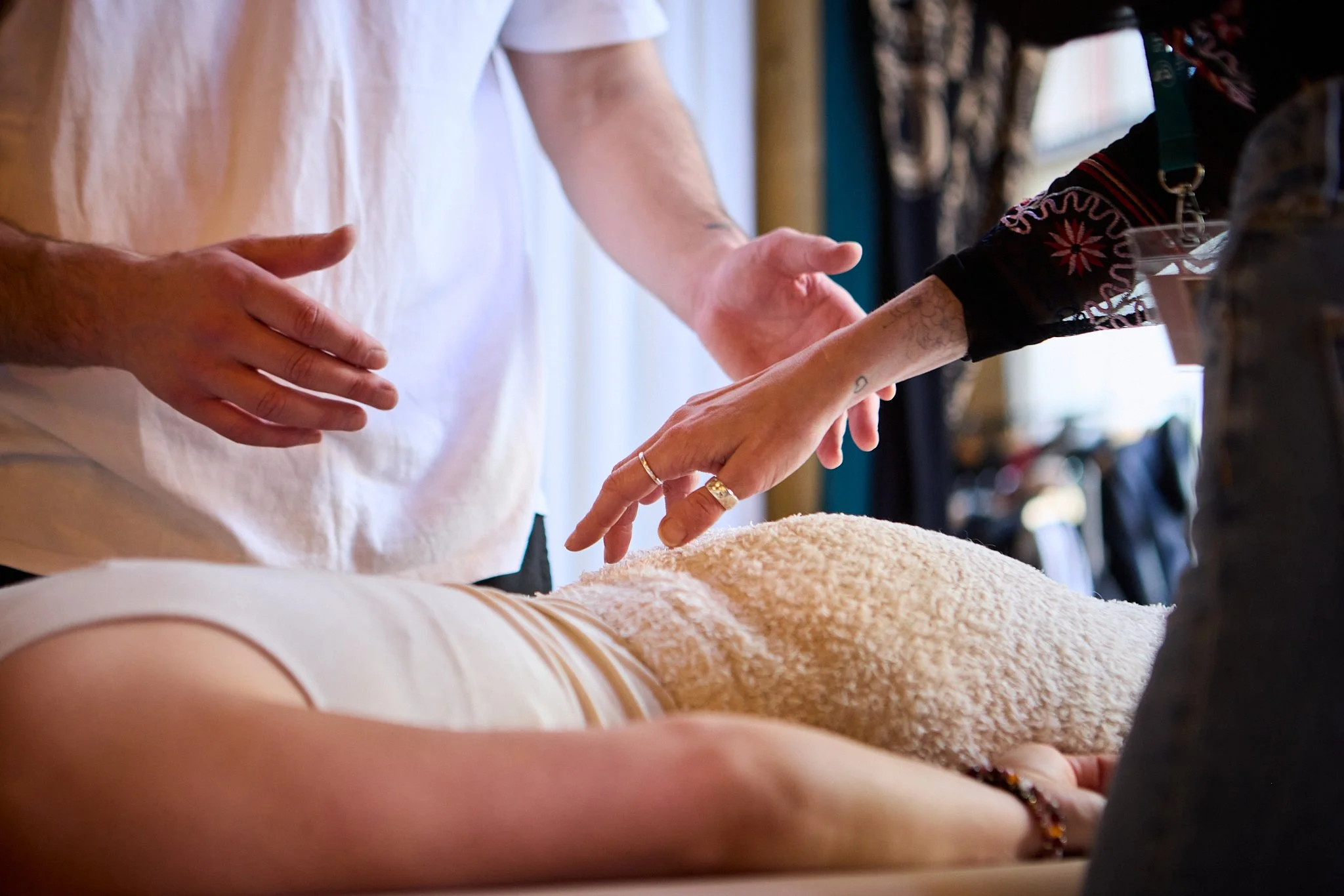
The spinal cord is not incidental to any of this. It is the superhighway of the nervous system, the structure through which the brain communicates with every organ, every muscle, every layer of the body, and through which the body communicates back. The vagus nerve, which has become something of a star in contemporary conversations about trauma and regulation, runs intimately alongside it. The energy centres described in yogic anatomy, the chakras, map almost precisely onto the major nerve plexuses along the spine. Whether you approach this from a neurological or an energetic framework, you arrive at the same conclusion: the spine is central.
When Spinal Energetics works with the spine, it is working with this entire system, not just the physical structure but the nervous system intelligence housed within it, and the energetic and consciousness dimensions that both ancient wisdom and emerging science suggest are inseparable from it. The reorganisation that happens in this work is not imposed from the outside. It arises from within the system itself, as layers of accumulated holding begin to release and the nervous system remembers a capacity for coherence, openness, and aliveness that was always there beneath the noise.
The most intimate frontier
Integral frameworks describe human development as occurring across multiple lines simultaneously, cognitive, emotional, interpersonal, spiritual, and somatic, and note that growth in one area does not automatically produce growth in another. You can be intellectually sophisticated and somatically shut down. You can be spiritually sincere and neurologically stuck in survival. The nervous system is its own line of development, and it deserves the same quality of attention and care that we bring to the cultivation of the mind.
To work with your nervous system is not a lesser form of spiritual practice. For many people, it is the missing one.